High security · Newmarket
Safe Opening & Combination Change
The bookkeeper who set the office safe's code retired in a hurry, and the float cash for tomorrow's registers is sitting behind a keypad nobody else in the building can operate.
In plain words
Two different problems can look identical from outside a locked safe: a combination that genuinely no longer opens it, and a mechanism that is jammed, corroded or blocked while the correct numbers still work perfectly. Sorting out which one is happening comes before any decision about drilling, since a stuck handle or a tripped relocker needs freeing rather than a fresh combination. Getting this diagnosis right the first time keeps the visit focused on the actual cause rather than the symptom in front of you.
How the visit goesA safe sat in a late parent's basement for years, its combination known to nobody left in the family, and everyone would like to know what is actually inside it.
Safe Opening & Combination Change
How the visit goes
Confirming who has the authority to open it
Before any tool touches the safe, the locksmith establishes who has the right to be inside it. For a business this is usually straightforward: an owner, manager or authorized employee identifies themselves and their connection to the account. For an estate, a secondhand purchase or a change of ownership, proof such as a bill of sale, a property transfer or an executor's documentation fills the same role. This step is treated as routine good practice rather than an obstacle, because it protects the current owner from a later dispute over who authorized access to a safe's contents just as much as it protects anyone else with an interest in it.
Repairing or replacing the lock afterward
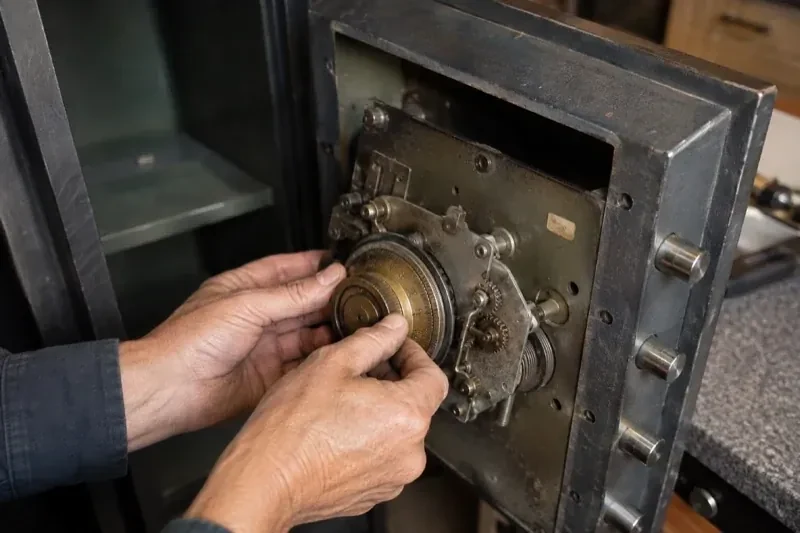
Once the safe is open, the lock that caused the trouble gets its own decision. A worn or damaged mechanical lock can often be repaired in place, its wheel pack, drive cam or spindle replaced individually rather than swapping the whole assembly. A failed electronic lock is more often replaced outright with a comparable or higher-rated unit, since circuit boards and keypads are not field-serviceable like a wheel pack. Either path aims for a lock at least as capable as the one it replaces, matched to the case's existing cutout, though restoring the safe's overall rated protection after any field repair follows the manufacturer's approved method rather than being assumed automatic.
A plan for the day this happens again
Most safes that needed a reset today will need one again eventually, whether from a future staff change, a forgotten code, or simple wear on an aging lock. Deciding now who is responsible for passing the combination along when roles change, keeping a written record somewhere secure, and having the safe's model and service history noted somewhere accessible all make the next visit shorter and simpler than this one. None of this is required before the locksmith leaves, but a few minutes spent on it now is the difference between a short reset next time and starting from an unknown safe all over again.
Safe Opening & Combination Change
In the van
Replacement dial and ring
Combination change key
Manufacturer reset tool
Nine-volt and lithium batteries
Drill rig and carbide bits
Safe Opening & Combination Change
What affects the quote
Any upgrade chosen during the same visit
Moving to a higher-rated lock, adding a second user code, or fitting an anti-relock plate is optional and priced as its own line whenever an owner chooses it.
Lock type: mechanical dial, electronic keypad or key
Each lock family calls for different tools and a different amount of time on site, and a safe with more than one lock, such as a keypad backed by a mechanical dial, involves assessing both.
Number of new codes needed afterward
Setting one combination for a single owner is the simplest case; programming separate codes for several staff members on an electronic lock takes correspondingly more time.
What to have ready
- What brand and model is the safe, if you know it?
- Is there a data plate or any paperwork you can find?
- Do you own the safe, or manage it for someone else?
Safe Opening & Combination Change: questions
QuestionsMy electronic safe lock has a dead battery. Do you still need to drill it?
Usually not. It depends on the model. Some electronic locks offer an external contact for a fresh battery, or a mechanical override key behind a cover plate; restoring power this way wakes a dead keypad but does not bypass a lost code on its own. Others have a reset port on the lock body, which sits inside the safe and still needs the door opened by other means first. The locksmith works through that model's own documented procedure before considering anything more invasive.
How is a new combination actually chosen and set?
You choose the numbers yourself, within whatever range and spacing that lock's rules allow, rather than being handed a default sequence. On a mechanical lock the locksmith uses a manufacturer change key to reset the wheel pack to your chosen combination; on an electronic lock the new code is entered directly through the keypad or a connected programming tool. Either way it is tested several times, door open and then closed, before the visit is considered complete.
Is a mechanical dial or an electronic keypad the better choice for a business safe?
Each suits a different way of working. A mechanical dial has no battery to fail and a long service life, but only ever holds one combination at a time. An electronic keypad allows separate codes for different staff and an audit trail on some models, at the cost of needing battery changes. Either can be fitted with a genuinely high security rating; the choice usually comes down to how many people need independent access.