Commercial · Newmarket
Panic & Exit Hardware in Newmarket
After the fit-out, the gym floor now holds more people than the old office space ever did, and the exit door at the back still has the same turn-lock it had when the room held desks.
In plain words
A pair of doors is its own small project, and not every pair needs the same approach. Some rim-device pairs keep their mullion and latch each leaf independently with no set closing order. Where sequencing does matter, one leaf is chosen as the inactive leaf and closes first, guided by a coordinator so the active leaf's device can seat properly into the strike or into an astragal on the inactive leaf. Removing a centre mullion calls for a compatible replacement arrangement on each leaf, which can matter for wheelchair access or for moving equipment through.
How the visit goesA padlock went on the stockroom's back door years ago for security and nobody has thought about it since, until the walkthrough this week pointed out that the same door is the room's only other way out.
Panic & Exit Hardware
How the visit goes
Confirming why the door needs this hardware
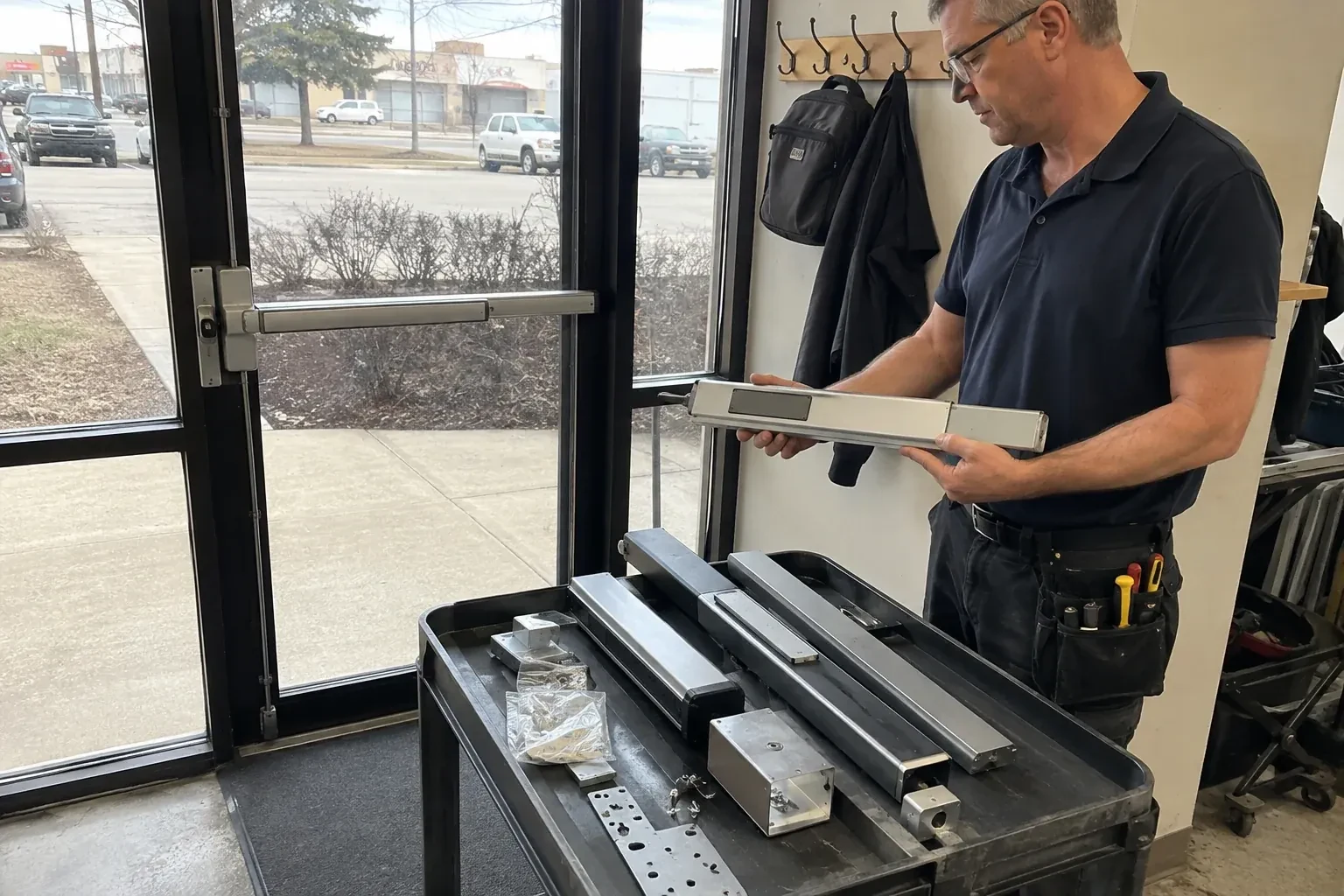
The visit starts with the reason exit hardware is being discussed at all: an occupant load that has crossed a threshold, a fire inspector's note, a new use for the room, or an existing device that has stopped working the way it should. Confirming this first decides everything downstream, because a door required to have a releasing device is treated differently from one where an owner simply wants easier egress. Whoever is responsible for the building is asked directly what triggered the visit, and the answer is recorded alongside the door it concerns before any hardware is chosen.
Handling a pair of doors
On a pair, a coordinator is fitted only where the hardware needs the leaves to close in a set order, letting the active leaf's device seat into the strike or into an astragal carried on the inactive leaf; many pairs latch independently and skip this step entirely. Where the plan calls for one wide exit instead of two narrow ones, the centre mullion is removed and vertical-rod devices are fitted to each leaf instead, arranged so both close and latch reliably. Either way, both leaves are tested together, not only on their own, before the visit is called finished.
A pair of doors that behaves like one exit
Where a pair was involved, both leaves now latch the way that pair's hardware was designed to: some close in a fixed order guided by a coordinator, with an astragal or a compatible vertical-rod arrangement keeping the opening reading as a single wide exit, while others latch independently on their own without needing either. Anyone walking through it day to day should notice nothing except a door that swings, closes and latches without a hand having to guide the second leaf into place.
Panic & Exit Hardware
In the van
Request-to-exit switch
Door closer
Through-fixings and mounting hardware
Force gauge
Installation template and jig
Panic & Exit Hardware
What affects the quote
Outside trim selected
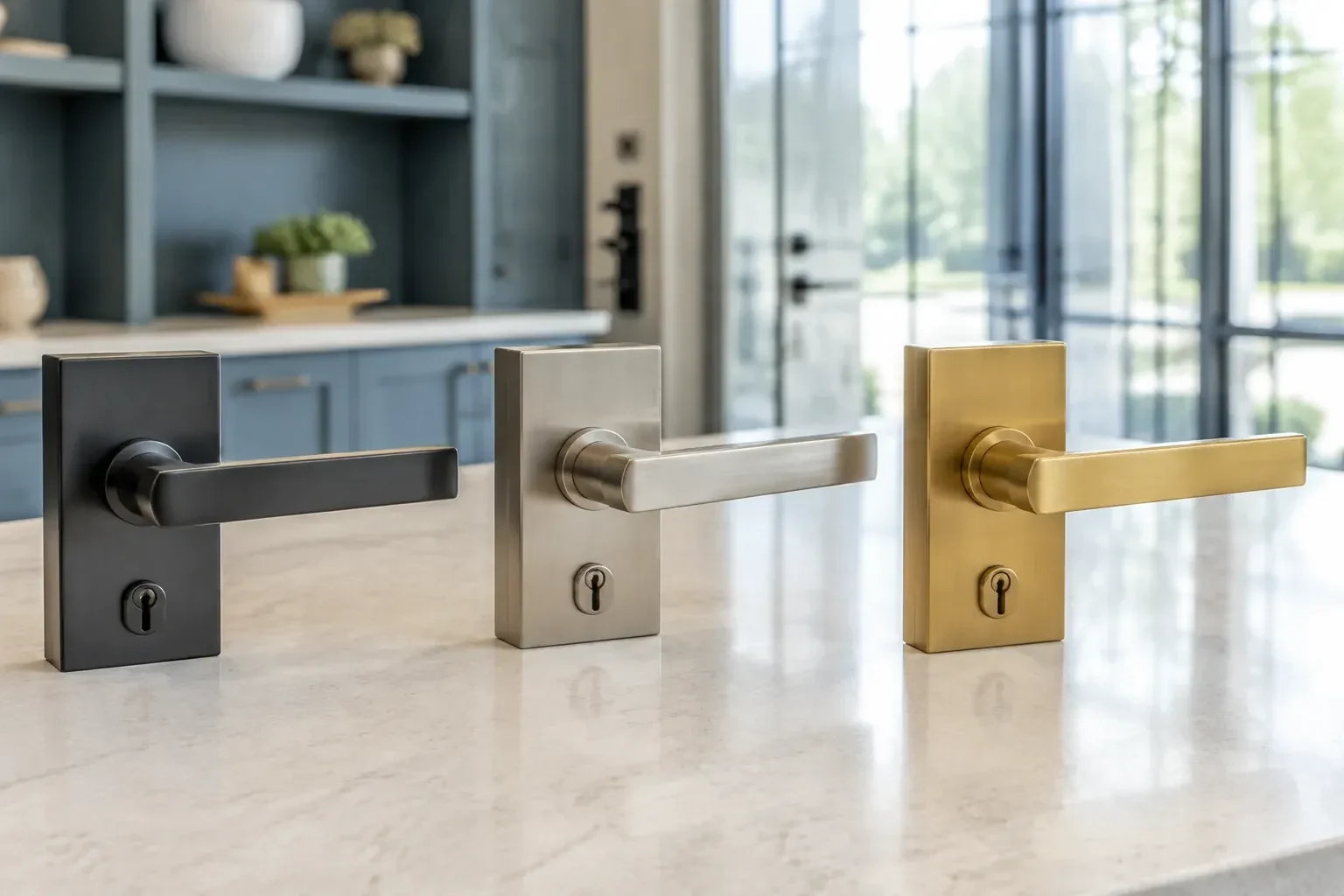
A plain pull is the simplest outside trim. A lever with a key cylinder, or a trim matched to other hardware finishes in the building, involves more parts and more fitting time.
Condition of the existing hardware
A device that only needs adjustment, cleaning and new fasteners costs less in labour than removing a seized or badly worn device and fitting a replacement in its place.
Access to the opening
A ground-floor commercial door is straightforward to reach. An opening behind scaffolding, up a stairwell with no elevator, or in a space still under active construction takes longer to work at.
What to have ready
- Has a fire inspector or building official already flagged a specific door?
- Is this for new construction, a renovation, or an existing building?
- Are any doors currently propped open during business hours?
Panic & Exit Hardware: questions
QuestionsHow is panic hardware different from fire exit hardware?
Panic hardware and fire exit hardware share the same push-to-release action, but fire exit hardware is additionally tested and listed for use on a fire-rated door assembly. That extra listing matters because a fire door has to keep an active latch bolt at all times; it cannot carry a mechanical dogging function the way ordinary panic hardware sometimes can, so the two are not interchangeable on a rated opening.
Can a padlock or extra deadbolt stay on a door that has this hardware?
No additional fastening should stay on an exit door that does not release the same way the primary device does. A hasp, padlock or separate deadbolt added at some point for extra security is a common finding on an older door, and removing or replacing it with something that releases under the same push is part of bringing that opening back to a single, reliable exit.
What does the finished installation actually prove to an inspector?
It proves that a specific device, rated for the opening it sits on, releases under an appropriate force, latches fully, and has been tested and recorded on a given date. The record travels with the building, so a fire inspector reviewing the space later is looking at a documented history of that exit rather than testing hardware with no known installation date or specification.
Related services
- Master Key System DesignA new hire at the shop gets handed whatever spare key happens to be in the drawer, and it turns out to open the stockroom, the back office and the safe room all at once.
- Access Control InstallationYou just leased the empty unit next door and want the new tenant to open their own suite without a key to yours, to the loading dock, or to the electrical room down the hall.
- Commercial-Grade Lock ReplacementAt closing time the hookbolt on the storefront door catches the keeper only on the second or third try, and one employee has started giving the door a shoulder to force it home.